Launching an event involves far more than securing a venue, creating a marketing campaign and putting a sales team to work.
Behind every successful event is a complex commercial ecosystem.
There is the market to understand, the audience to define, competitors to assess, venues and suppliers to manage, revenue to generate, costs to control, cash flow to protect and, ultimately, a business model that needs to make sense.
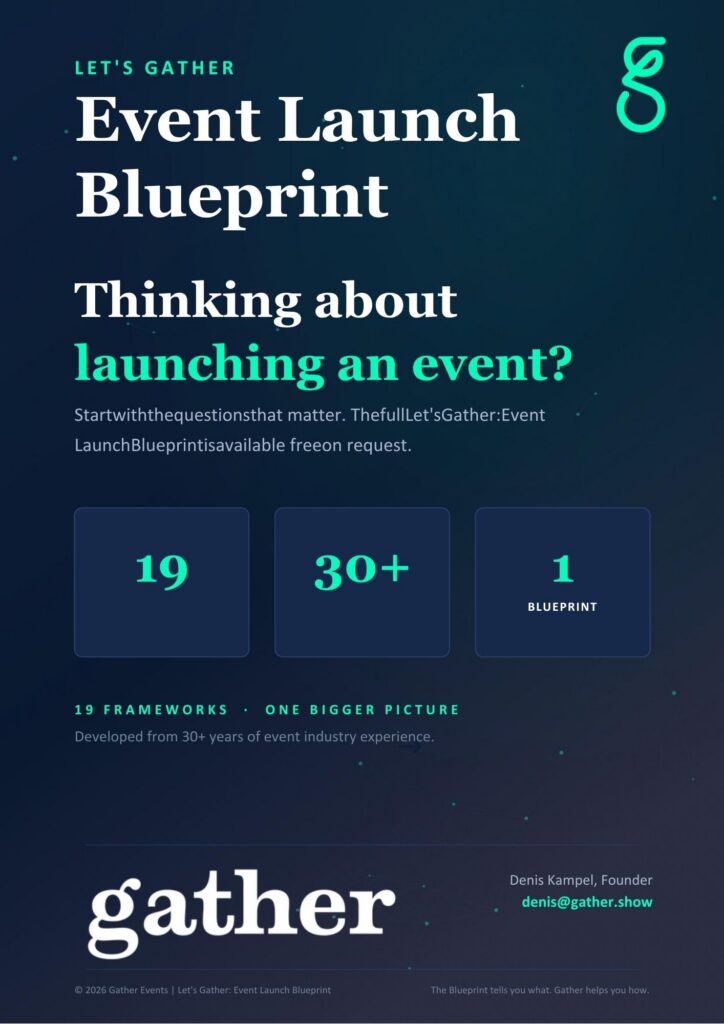
Recognising the need for a more structured way to approach event development, Gather Events has created the Let’s Gather: Event Launch Blueprint, a comprehensive framework designed to help event organisers understand the critical areas that need to be considered when developing, launching or scaling an event.
Built from more than 30 years of experience in the events industry, the Blueprint brings together 19 strategic frameworks, covering everything from the initial event concept through to commercial planning, financial modelling, risk management and funding.
What is the Event Launch Blueprint?
The Event Launch Blueprint is designed to help organisers look at an event from every important angle before committing significant time, resources and money.
It asks the questions that can easily get lost in the excitement of launching a new event.
- Who is the event for?
- Why will the market care?
- How will it generate revenue?
- What will it cost?
- When does cash need to be available?
- What happens if sales are slower than expected?
- What does the event need to deliver to break even?
- And, perhaps most importantly:
- Does the event make commercial sense?
The Blueprint is not intended to replace specialist event expertise. Instead, it provides a structured way of identifying the areas that require attention and the questions that need to be answered.
The 19 Event Launch Blueprint Frameworks
- The Big Picture
Establishes the overall event proposition, objectives, positioning, market opportunity and commercial ambition.
- Project Timeline
Maps the critical stages, milestones, dependencies and deadlines required to move the event from concept to launch.
- Competitor Intelligence
Looks at the competitive landscape, comparable events, market positioning and the gaps or opportunities that may exist.
- Delegate Profile Strategy
Defines who the event needs to attract, what those audiences need and why they would choose to attend.
- Market Engagement
Considers how the event will engage the wider market, build relevance and create momentum ahead of launch.
- Venue Engagement
Looks at venue suitability, commercial considerations, logistics, requirements and the role the venue can play in the overall event strategy.
- Sales Strategy
Establishes the approach to generating commercial revenue and building a sales pipeline around the event.
- Sales Profile Strategy
Identifies the sales audiences, prospect profiles and relationships required to convert commercial opportunities.
- Commercial Sales Plan
Brings the commercial opportunity into a structured plan covering revenue streams, targets, timing and sales activity.
- Market Strategy
Defines how the event will position itself within the market and build relevance, differentiation and demand.
- Amplification / Influencer Strategy
Identifies trusted voices, communities and amplification opportunities that can extend the event’s reach and credibility.
- Experience Strategy
Considers the attendee journey and the experience the event needs to create before, during and after the event.
- Associations, Media Partners & 3rd Party Strategy
Explores strategic relationships that can provide audience access, credibility, amplification, content and commercial value.
- Conference Strategy
Looks at the role of conference content, speakers, programming and thought leadership within the overall event proposition.
- Financial & Budget
Builds the financial picture across revenue, direct costs, overheads, scenarios, margins and break-even requirements.
- Prospectus Design
Considers how the commercial proposition should be packaged and presented to sponsors, exhibitors and other potential partners.
- Supplier Management
Addresses the supplier ecosystem required to deliver the event, including relationships, responsibilities, costs, timelines and dependencies.
- Cash Flow & Risk
Focuses on cash availability, payment timing, risk exposure, contingencies and the financial pressure points that can affect an event before launch.
- Funding Strategy
Looks at the capital required, when it is needed, potential funding sources, strategic partners, ownership and economics, and how funding connects to the broader commercial strategy.
From Concept to Commercial Reality
One of the biggest challenges in event development is that an idea can look excellent on paper without necessarily being commercially viable.
A compelling concept does not automatically create a sustainable event.
- The numbers need to work.
- The market needs to exist.
- The audience needs a reason to attend.
- Commercial partners need a reason to participate.
- The delivery model needs to be realistic.
- And the financial risks need to be understood before they become sunk costs.
The Blueprint is therefore designed to encourage organisers to stress-test the event before they over-invest in it.
That means looking at different financial scenarios, understanding break-even requirements, identifying cash-flow pinch points, assessing risks and considering what happens when assumptions change.
It also means recognising that revenue and funding are not the same thing.
A strong sales pipeline is valuable, but pipeline is not cash.
A strategic partner may offer far more than financial investment.
And solving a short-term funding problem should not automatically mean giving away long-term value.
These are the kinds of commercial questions that can fundamentally change how an event is planned.
Built From Experience
The Let’s Gather: Event Launch Blueprint has been developed by Gather Founder Denis Kampel, drawing on more than three decades working across the events industry.
The frameworks reflect the reality that event organisers face when taking an idea from concept to execution: multiple stakeholders, competing priorities, financial pressure, complex supplier ecosystems, changing markets and the constant need to balance creativity with commercial discipline.
As Denis puts it: “A great event idea is only the beginning. You need to understand whether the market wants it, whether you can sell it, whether you can deliver it and whether the numbers work.”
That thinking sits at the heart of the Blueprint.
Available to Event Industry Professionals
The full Let’s Gather: Event Launch Blueprint is available free to professionals working within the events industry.
Created from more than 30 years of event industry experience, the Blueprint brings together 19 strategic frameworks covering the critical considerations involved in developing, launching and scaling an event.
Whether you’re launching a new event, growing an existing one or testing the commercial viability of an event concept, the Blueprint provides a structured starting point for asking the right questions before committing significant time, resources and capital.
The full Blueprint is shared selectively with event industry professionals who can put its thinking to practical use.
Apply for your free copy by completing the form below.
Because before you build the event, you need to know what you’re building.
Let’s Gather – and build events that matter.